Modelling and Explaining Workforce Allocation at Airbus with CPMpy
As part the EU project Tuples [1] we had the opportunity of collaborating with Airbus Toulouse on a challenging workforce allocation and scheduling problem. Everyday, planners at Airbus factories need to schedule and allocate logistical tasks to worker teams. These tasks are incredibly diverse and range from the transportation of aircraft components from one hangar to another to the loading and unloading of Beluga® cargo planes.
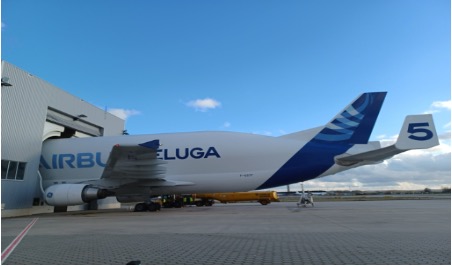
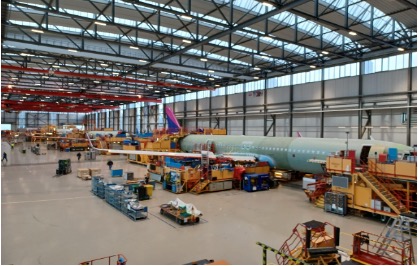
Timely execution of these tasks is essential for the operational efficiency of the factory. Indeed, any missed deadlines can cascade throughout the assembly lines and cause significant delays during production of the aircraft. The planning and allocation of these transportation tasks is mostly done by hand by an expert team of planners. They ensure that each task is executed on time, and by a worker team that has the required training for executing that task.
Using our expertise in constraint optimization, we collaborated with the research team at Airbus to develop a reliable, trustworthy and explainable decision support system for the planners. More specifically, we developed algorithms that can (1) propose an efficient and fair initial schedule that satisfies all operational constraints and (2) can help in resolving operational disruptions throughout the day.
Fair and Efficient Schedules
Using the open-source CPMpy constraint modelling library, we developed a Constraint Programming (CP) model to solve this large workforce-allocation and scheduling problem. CP is a declarative approach for solving combinatorial problems, where the user models their problem using integer variables and constraints; after which a general-purpose constraint solver is used to find an optimal solution to the problem. This technology is perfectly suited for this problem as any solution computed by the solver is guaranteed to satisfy all operational constraints.
Our model shares similarity with state-of the-art CP-models for flexible job-shop problems where the goal is to schedule a set of tasks onto a set of machines, where tasks cannot overlap. We used scheduling-specific global constraints, symmetry breaking techniques and a problem relaxation to efficiently find optimal solutions to the allocation and scheduling problem. Unique to this use-case of workforce allocation are the objectives we aim to optimize. In traditional scheduling problems, it is common to minimize the makespan. However, for our problem, we construct a bi-objective optimization problem with the following objectives:
- Minimize the number of worker-teams used to execute the schedule
- Optimize fairness of the schedule, such that no team is needlessly overused or underused. The fairness is formulated as the “time-dispersion”, which is expressed formally as $max_{t \in Teams} (time_worked_t) - min_{t \in Teams} (time_worked_t)$
We experiment with two variants of the problem: a pure-allocation and an allocation+scheduling setting. In the pure allocation setting, planners first determine the start-times of each task, and use the CP-model to allocate the tasks to a team. This reflects their current workflow as tasks are scheduled given an order book for the coming planning period. In the allocation+scheduling setting, the solver is free to chose the start-time of each task, given its earliest start-time and deadline.
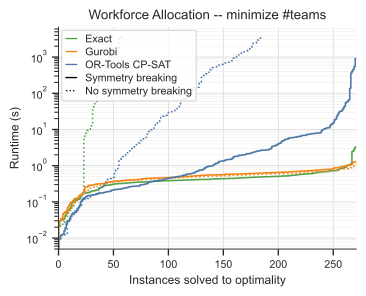
Our experiments showed that using clever modelling techniques such as symmetry breaking constraints, most solvers can find optimal solutions for the pure-allocation setting when minimizing the number of teams in the schedule; and ILP solver Gurobi and Pseudo-Boolean solver Exact perform best among the solvers we tested.
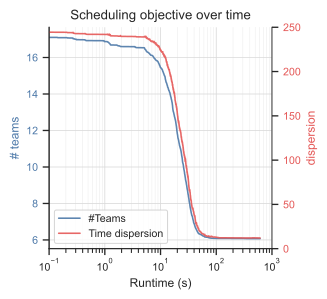
While truly optimal solutions with respect to the fairness objective are rarely found, experiments showed that fair schedules can be found within a couple of seconds using modern solvers. Indeed, the right plot shows the how the objectives change over time for the allocation+scheduling problem (the most difficult variant). Here we clearly see the objective decreases rapidly at the start of the solving process.
Explaining and Resolving Disruptions
In our research lab, we have been working on explainable constraint solving: we have studied methods not just for efficiently finding solutions, but also for explaining the answer of a constraint solver to a user.
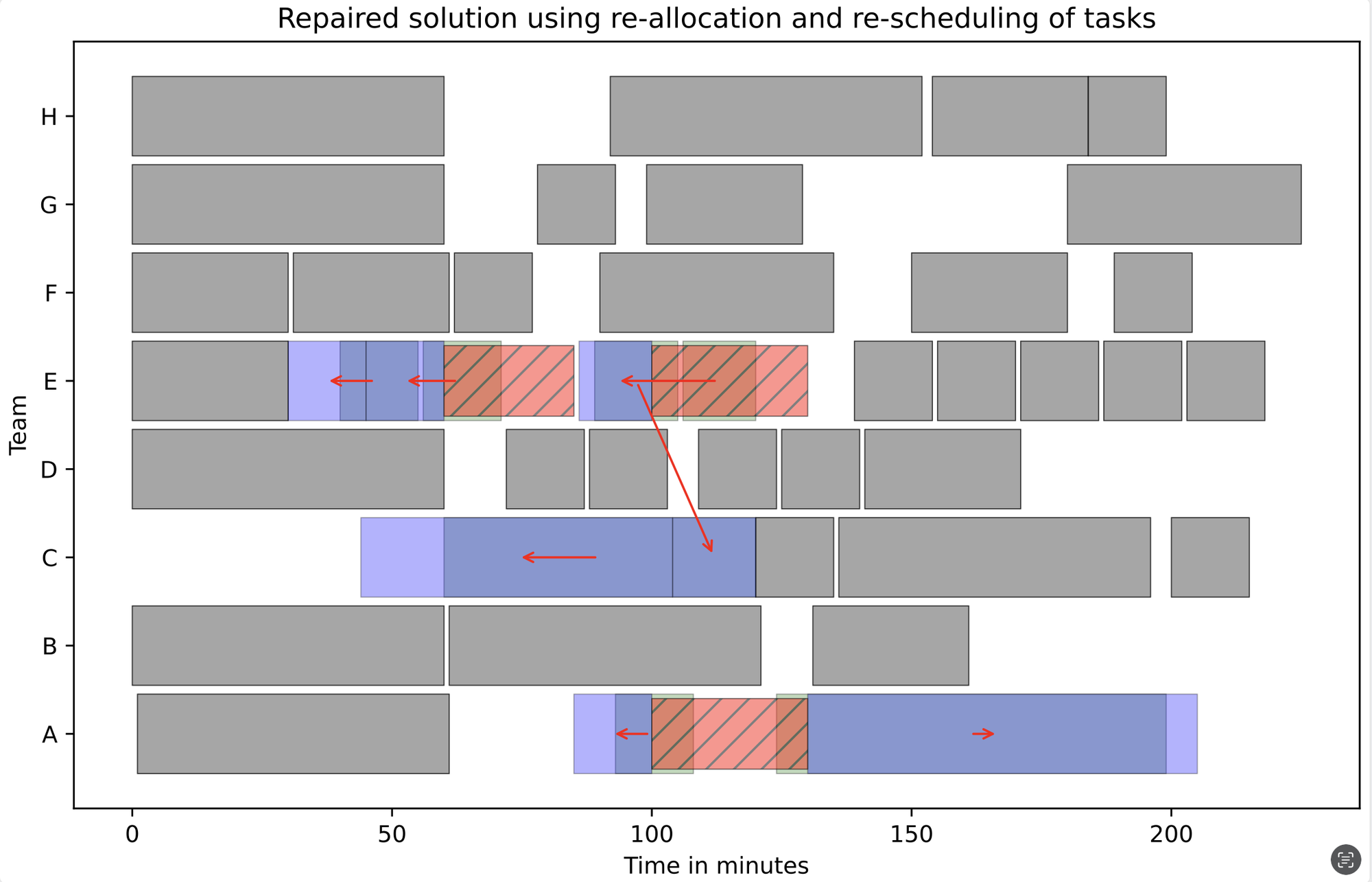
For this project, a big hurdle for the planners is to understand the consequences of a disruption and how to resolve them. Examples of disruptions are technical malfunctions or unexpectedly adverse weather conditions that cause a resource or worker team to be unavailable for a certain amount of time. Such disruptions are common and almost unavoidable.
In collaboration with Airbus, we proposed a method to help the planners resolve disruptions by computing a new schedule which is as similar as possible to the initial schedule. More precisely, we compute a new schedule which (1) does not call in any extra teams; (2) minimizes the number of reallocated tasks and (3) minimizes the delay of tasks compared to the initial schedule.
This ensures the repaired schedule impacts the least number of teams operating on the plant and reduces the cognitive load on the planners to interpret the newly computed schedule. Moreover, as the new schedule uses the original CP-model, the new schedule is guaranteed to satisfy all operational side-constraints as well.
Acknowledgements
We are honoured that are work was recognized by the CP 2025 Best Application Award, and thank our collaborators at Airbus for this inspiring and fruitful collaboration.
References
- Tuples | Trustworthy AI, Tuples.ai. (2023). https://tuples.ai/
- Bleukx, Ignace, Ryma Boumazouza, Tias Guns, Nadine Laage, and Guillaume Poveda. “Modeling and explaining an industrial workforce allocation and scheduling problem.” Leibniz International Proceedings in Informatics 340 (2025).

Ignace Bleukx
Post-doc
