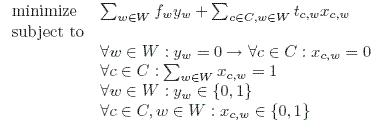
It was basically a traditional MIP
model, exploiting some of the CHIP coroutining facilities to link the
warehouse variables  and the decision variables
 assigning the customers to the warehouses. I showed the model to
Hervé and you could see he was disappointed by the model and the
performance, although he was too diplomatic to say so directly.
Herv´e always had very high standards, which included coming to
ECRC before, and leaving after, anyone else. I then wrote another model
which was much more efficient. Using mathematical notations, this model
could be written as
and the decision variables
assigning the customers to the warehouses. I showed the model to
Hervé and you could see he was disappointed by the model and the
performance, although he was too diplomatic to say so directly.
Herv´e always had very high standards, which included coming to
ECRC before, and leaving after, anyone else. I then wrote another model
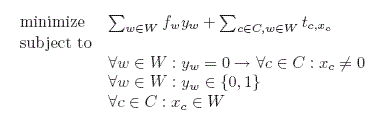
which was much more efficient. Using mathematical notations, this model
could be written asThe key is the expression  which features the element constraint, avoiding the 0/1 decision variables .
The warehouse location opened a pandora box for us: constraints did not
have to be numeric: They could capture any relation and hence preserve
the high-level structure of the applications. I gave the talk on the
resulting paper at AAAI’88 and Ken McAloon was in the audience
(there were more people this time around). He was amazingly encouraging
and excited about the benefits of capturing the structure of
applications.
After that, we saw element constraints everywhere. Helmut started solving the car-sequencing problem with the element constraint. However the issue was how to express the demand constraints on the cars. Helmut obviously did not want to introduce 0/1 variables and he asked me if I had another idea (recall that we were separated only by two (bulky) monitors). The pandora box was open and I told him that it was easy to introduce this cardinality constraint in CHIP. Once again, we had captured another important substructure, simply by considering an interesting application. The resulting program would quickly solve small instances but would backtrack forever on large ones. Helmut then built a visualization of the program and we spent time looking at the screen and understanding what was going on. We eventually realized that the propagation was only detecting failures very late. We designed redundant constraints (which are sometimes called implied constraints now) to address this pathological behaviour and obtained the program described in our ECAI’88 paper. The car-sequencing application was an amazing learning experience for us. It led to cardinality constraints, to visualizations, and to redundant constraints. The modeling itself removes symmetries (cars requiring the same options are interchangeable) and was the motivation for Freuder’s paper in 1992 on interchangeability. Jean-François Puget also told me once that this paper attracted him to the area.
which features the element constraint, avoiding the 0/1 decision variables .
The warehouse location opened a pandora box for us: constraints did not
have to be numeric: They could capture any relation and hence preserve
the high-level structure of the applications. I gave the talk on the
resulting paper at AAAI’88 and Ken McAloon was in the audience
(there were more people this time around). He was amazingly encouraging
and excited about the benefits of capturing the structure of
applications. After that, we saw element constraints everywhere. Helmut started solving the car-sequencing problem with the element constraint. However the issue was how to express the demand constraints on the cars. Helmut obviously did not want to introduce 0/1 variables and he asked me if I had another idea (recall that we were separated only by two (bulky) monitors). The pandora box was open and I told him that it was easy to introduce this cardinality constraint in CHIP. Once again, we had captured another important substructure, simply by considering an interesting application. The resulting program would quickly solve small instances but would backtrack forever on large ones. Helmut then built a visualization of the program and we spent time looking at the screen and understanding what was going on. We eventually realized that the propagation was only detecting failures very late. We designed redundant constraints (which are sometimes called implied constraints now) to address this pathological behaviour and obtained the program described in our ECAI’88 paper. The car-sequencing application was an amazing learning experience for us. It led to cardinality constraints, to visualizations, and to redundant constraints. The modeling itself removes symmetries (cars requiring the same options are interchangeable) and was the motivation for Freuder’s paper in 1992 on interchangeability. Jean-François Puget also told me once that this paper attracted him to the area.
Just do it, then clean the mess:
Alan Perlis once wrote that “simplicity does not precede complexity, but follows it”. It is indeed difficult to isolate the right concepts or abstractions immediately or to come up with the right design the first time. It is just how science works. We have to see the same patterns several times before recognizing them and determining how important they are. CHIP was sometimes criticized because it was growing in an ad-hoc fashion. But we could not see the proper abstractions or did not have the knowledge to simplify the concepts at the time. When I joined Brown in 1990, my goal was to clean the mess and I started working on the cc(FD) system. Ole Madsen, speaking about the BETA programming language said that “ there were always two criteria for adding a construct to the language: it should be meaningful from a modeling standpoint as well as from technical standpoint.” Together with Yves Deville and Vijay Saraswat, I took the modeling road and try to find generic abstractions to build all the ad-hoc constraints of CHIP. It led to the cardinality operator, constructive disjunction, reification, and indexicals. Many of the ad-hoc constraints of CHIP were now easy to build in the language using logical or cardinality combinators. Nicolas Beldiceanu and Jean-Charles Régin took a more algorithmic road and studied how to increase the algorithmic power of constraints. Jean-Charles’ papers were especially elegant because they removed the ad-hoc aspects of algorithmically sophisticated constraints and showed how to enforce arc consistency on complex constraints using matching and flow algorithms.Strive for the declarative ideal:
I have mentioned several times already the importance of declarative abstractions and, in terms of Alain’s slogan, the contribution of the CHIP system can be summarizedThe Power of CHIP = Declarative Filtering + Nondeterminism.
Nowadays filtering algorithms are
typically specified declaratively. They are not just a bag of
implementation tricks, but rather they specify the properties enforced
when the propagation step converges. This property should ideally be
arc consistency, but it has to be relaxed for some constraints whose
feasibility problems are NP-complete, such as the edge finder for
disjunctive and cumulative scheduling. There are significant benefits
in having these declarative specifications. First, they allow
programmers to reason about their program behavior and complexity.
Second, they define an algorithmic problem for which algorithmic and
complexity results can be derived. Finally, they allow for effective
compiler optimizations and model transformations.
The CHIP project did not take place in isolation of course. In fact, much of the success of constraint logic programming in the late 80s came from the synergy between several groups, including BNR-Prolog, CHIP, CLP(R), and Prolog III. I have already mentioned the impact of Alain on CHIP and I will describe the impact of BNR-Prolog on Numerica shortly. Obviously, there is no need to highlight the scientific impact of the CLP scheme and how it crystallized the essence of constraint logic programming. These were exciting times for all of us and most of the PhD students in these groups are still passionate about constraint programming twenty years later.
The CHIP project did not take place in isolation of course. In fact, much of the success of constraint logic programming in the late 80s came from the synergy between several groups, including BNR-Prolog, CHIP, CLP(R), and Prolog III. I have already mentioned the impact of Alain on CHIP and I will describe the impact of BNR-Prolog on Numerica shortly. Obviously, there is no need to highlight the scientific impact of the CLP scheme and how it crystallized the essence of constraint logic programming. These were exciting times for all of us and most of the PhD students in these groups are still passionate about constraint programming twenty years later.